Wednesday, October 15, 2008
Black Sea: Constanta to Varna
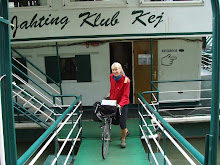
These last few photos are of the end of my bike ride to the Black Sea. It was just under 200 kilometres from Constanta to Varna. The highlight of the trip down was the town of Balchik in Bulgaria, where I rested up after a brutal day of fighting a very strong and consistent headwind. The dozens of wind turbines along the way was an indication that the wind was not unusual and I dreaded much more of it . . . In Balchik I found a quiet and cheap hotel away from the main hotel drag; from my room I could see, smell and hear the sea. I also scored a 90 minute massage in the hotel. It was evident that the time was coming to give up the bicycle. My last day was a short one to Varna, but my tire went flat again and my right pedal was clicking loudly. I was glad to arrive at the Yo Ho Hostel in Varna after some searching for it; I spent another rest day in Varna and put myself and my bike on the bus to Istanbul the next day.
posted in Fethiye, Turkey: 6429 km to Varna
Sunday, October 12, 2008
Istanbul
I arrıved ın Istanbul two days ago and am havıng a great tıme ın thıs exotıc cıty. I have been enjoyıng the sıghts and sounds too much to settle and wrıte, but wıll do so soon. What a welcome change from rural Romanıa!
Happy Thanksgıvıng to the Canadıans!
Friday, October 3, 2008
Romanian Danube to the Black Sea
September 20 - October 1, 2008
Just as I was taking my last gulp of familiar Serbian air before committing myself to the Romanian border checkpoint on September 20, two young Swiss women I had met in Smederevo four days before, Rebecca and Angelica, cycled up behind me. They waited for me while my Canadian passport underwent the usual thorough scrutiny, then we cycled into Romania together. Their company made the transition to this much-maligned country easier. Unfortunately, we parted in the first town, Drobeta-Turnu Severin, because although I had cycled less than 30 km, my left knee was stiff and sore from the fall three days before; the long and steep hills of the Danube Gorge over the previous two days had probably made it worse. I tried not to mind too much that I couldn't continue with them, but in fact I had been hoping for the company of other cyclists for the 800 km trek across Romania. I had weighed the risks of cycling alone against my strength and experience as a cyclist, the good condition of my bike, and my careful calculation of the distances between towns with accommodations, which looked just doable within the shortening daylight, all going well. But I couldn't do the distances with my knee in that condition, and I didn't want to be stranded if I tried and failed. "I sure as hell wouldn't want to camp in Romania" had worn a groove in my brain. So I cooled my heels and iced my knee at the Hotel Continental in Drobeta-Turnu Severin for two days, enjoying a room with a Danubian view, learning some key Romanian phrases, and writing about Serbia. The hotel claimed to be a "four star hotel with three star prices" (my single room was 170 new Romanian lei, about $75 CAD a night) but I soon realized I was back in the developing world: the light in the bathroom didn't work and neither did the bedside lamp; there didn't seem to be hot water when I wanted to shower, and the power went out as I sat down to use the computer. These problems were beyond the scope of the desk staff to solve, but I knew what to do from years spent in similar settings: grope, shiver, and shrug.
I set out for the next town, Hinova, two days later. It was less than 20 km down the road, but the cycling guide warned it was the last town with accommodation before Calafat, 120 km away, and I wanted to have a warm-up day, and situate myself as close to Calafat as possible. In fact, Hinova's one motel was not in operation, and I had to cycle all the way back to the edge of Turnu Severin, where I checked into a motel. The next day's ride was 137 km as a result; the day after, to Corabia, 147. Long days but in good weather. In both Calafat and Corabia I felt affection for the towns' rustic run-down nature and found the peeling post-office and the non-flushing toilet almost humourous. My view was coloured by my first days' cycling success and newness to Romania. Anyone familiar with the classic culture shock wave will recognize the "honeymoon" phase, and knows it's downhill from there. My initial response reminds me of a time in China when Susan and I, with some visiting friends, got locked inside our sixth floor apartment again, due to a malfunctioning lock. As we struggled in vain to open the door, a woman from Canada who had been in China just three days was laughing, merry, "ha ha, only in China, ha ha ha." She provided a perfect example of someone in the honeymoon phase, where everything new is wonderful. I, on the other hand, somewhere way down in the trough, fumed in frustration and rage.
Perhaps I wouldn't have plummeted quite so fast to my Romanian trough had the weather not deteriorated. Three days of rain followed with the cruel addition of a consistent headwind and bumpy roads. The distances required between towns were smaller--32, 56, and 78 km--but the days were just as tiring as my pace slowed and the uncomfortable hours mounted. The villages I passed lost their quaintness; they were mired in mud and the grey days sucked the colour out of them and the sodden fields. The general disrepair was dispiriting. In Zimnicea, many of the buildings are still skeletal after the 1977 earthquake. I reached the nadir in the city of Giurgiu. The first hotel I approached spooked me with its empty industrial location and I hoped I wouldn't have to stay there. A bright and friendly woman thankfully emerged on the front steps, put her warm hand on my arm and redirected me to the Motel Prietenia. There I was checked in by a woman who was so cold in her manner that I got the impossible impression that she hated me. (A great irony is that "prietenia" means "friendship". The motel was probably named after the "Friendship Bridge" between Giurgiu and Ruse in Bulgaria, which in another irony, for years no one was able to use.) Ensconced in my room, I decided, as I stared unhappily across the train tracks at the ugly stained concrete apartment blocks with soggy laundry hanging limp from windows, not a tree in sight, that Giurgiu qualified as a "shithole."
The next day my outlook improved with smooth roads, weak fall sunshine, and a corresponding increase in my pace. Gone were the dawdling days of riverside picnics and dropping in on castles and cafes; I was in a daily race to get to my next hotel room: Calafat, Corabia, Turnu Magurele, Zimnicea, Giurgiu, Oltenitsa, Calarasi . . . and finally, Constantsa on the Black Sea.
The ride to Constantsa was going to be the longest yet at around 150 km, and the morning I was going to do it I woke up feeling just not ready. I was worried about my knee; also, for the first time in almost 6000 kilometres, I had sore sit bones. These two physical problems had sapped the joy from cycling, but I was also worried about the untrueness of my rear wheel. By the time I opened my eyes on the day, I had decided that the wheel was wandering a centimeter away from true with every rotation, and that I should take it to the bike shop I had seen on my way into Calarasi the day before. When I got the bike out to look at it, I realized my anxiety about the ride had inflated the degree of the wheel's untrueness; it was noticeable but only a couple of millimetres. And besides, all the spokes were tight; closer inspection revealed that the rim was damaged. I'm pretty sure it happened on the day of heaviest rain, when the roads in some places were half muddy lakes. In spite of my frequent self-reminders to be careful of the cracks and potholes lurking under the water's surface, I fell into a deep hole at speed, which shook the bike and me with a tremendous jarring rattle. I think the rim was hit by the pavement on the way in or out of the hole. This kind of damage can only be remedied by wheel replacement and my wheel size is unlikely to be found in this part of the world. The problem shrank back to its real size (small) and I went out to spend my rest day exploring Calarasi on foot. It was a warm fall day and it was restorative to look in shops and meet people at a walking pace.
The next day I was on the road just after first light (7:40), exulting in the promise of the sunny morning. Get up early enough, and anything seems possible. I caught the ferry across the Danube to the edge of Silistra in Bulgaria, and made my first climb of the day, over cobblestones, to a ride with a view of vineyards sloping to the river. Just after ten I arrived at Dervent Monastery, with its garden and view of the plain. The man sweeping up around the entrance asked me if I were alone--my answer, yes, entitled me to sleep there. I was so fresh and keen to go that I declined, a decision I regretted within a couple of hours. The ride was the best yet of my journey since the Danube Gorge, with its rolling hills and views, and the warm (but not hot) day with a tailwind. But. because of the ferry ride and the cobblestones, I was already behind schedule when I got to the monastery, and I should have known better than to think I could catch up. The result was a ride spoiled by the need to push it all the way to Constanta with barely time to eat or rest, and also no time to properly visit the archaelogical site at Adamclisi. Every town with a cobbled street got my curses but the curses didn't help my speed. The tailwind did, though, and I was very fortunate to have it as I flew the last 50 km into the city at about 25 to 30 kph, a good pace. I reached Constanta at 6:00 with less than an hour to spare before dark, much later than I am comfortable arriving without a place arranged to stay.
Just as I was taking my last gulp of familiar Serbian air before committing myself to the Romanian border checkpoint on September 20, two young Swiss women I had met in Smederevo four days before, Rebecca and Angelica, cycled up behind me. They waited for me while my Canadian passport underwent the usual thorough scrutiny, then we cycled into Romania together. Their company made the transition to this much-maligned country easier. Unfortunately, we parted in the first town, Drobeta-Turnu Severin, because although I had cycled less than 30 km, my left knee was stiff and sore from the fall three days before; the long and steep hills of the Danube Gorge over the previous two days had probably made it worse. I tried not to mind too much that I couldn't continue with them, but in fact I had been hoping for the company of other cyclists for the 800 km trek across Romania. I had weighed the risks of cycling alone against my strength and experience as a cyclist, the good condition of my bike, and my careful calculation of the distances between towns with accommodations, which looked just doable within the shortening daylight, all going well. But I couldn't do the distances with my knee in that condition, and I didn't want to be stranded if I tried and failed. "I sure as hell wouldn't want to camp in Romania" had worn a groove in my brain. So I cooled my heels and iced my knee at the Hotel Continental in Drobeta-Turnu Severin for two days, enjoying a room with a Danubian view, learning some key Romanian phrases, and writing about Serbia. The hotel claimed to be a "four star hotel with three star prices" (my single room was 170 new Romanian lei, about $75 CAD a night) but I soon realized I was back in the developing world: the light in the bathroom didn't work and neither did the bedside lamp; there didn't seem to be hot water when I wanted to shower, and the power went out as I sat down to use the computer. These problems were beyond the scope of the desk staff to solve, but I knew what to do from years spent in similar settings: grope, shiver, and shrug.
I set out for the next town, Hinova, two days later. It was less than 20 km down the road, but the cycling guide warned it was the last town with accommodation before Calafat, 120 km away, and I wanted to have a warm-up day, and situate myself as close to Calafat as possible. In fact, Hinova's one motel was not in operation, and I had to cycle all the way back to the edge of Turnu Severin, where I checked into a motel. The next day's ride was 137 km as a result; the day after, to Corabia, 147. Long days but in good weather. In both Calafat and Corabia I felt affection for the towns' rustic run-down nature and found the peeling post-office and the non-flushing toilet almost humourous. My view was coloured by my first days' cycling success and newness to Romania. Anyone familiar with the classic culture shock wave will recognize the "honeymoon" phase, and knows it's downhill from there. My initial response reminds me of a time in China when Susan and I, with some visiting friends, got locked inside our sixth floor apartment again, due to a malfunctioning lock. As we struggled in vain to open the door, a woman from Canada who had been in China just three days was laughing, merry, "ha ha, only in China, ha ha ha." She provided a perfect example of someone in the honeymoon phase, where everything new is wonderful. I, on the other hand, somewhere way down in the trough, fumed in frustration and rage.
Perhaps I wouldn't have plummeted quite so fast to my Romanian trough had the weather not deteriorated. Three days of rain followed with the cruel addition of a consistent headwind and bumpy roads. The distances required between towns were smaller--32, 56, and 78 km--but the days were just as tiring as my pace slowed and the uncomfortable hours mounted. The villages I passed lost their quaintness; they were mired in mud and the grey days sucked the colour out of them and the sodden fields. The general disrepair was dispiriting. In Zimnicea, many of the buildings are still skeletal after the 1977 earthquake. I reached the nadir in the city of Giurgiu. The first hotel I approached spooked me with its empty industrial location and I hoped I wouldn't have to stay there. A bright and friendly woman thankfully emerged on the front steps, put her warm hand on my arm and redirected me to the Motel Prietenia. There I was checked in by a woman who was so cold in her manner that I got the impossible impression that she hated me. (A great irony is that "prietenia" means "friendship". The motel was probably named after the "Friendship Bridge" between Giurgiu and Ruse in Bulgaria, which in another irony, for years no one was able to use.) Ensconced in my room, I decided, as I stared unhappily across the train tracks at the ugly stained concrete apartment blocks with soggy laundry hanging limp from windows, not a tree in sight, that Giurgiu qualified as a "shithole."
The next day my outlook improved with smooth roads, weak fall sunshine, and a corresponding increase in my pace. Gone were the dawdling days of riverside picnics and dropping in on castles and cafes; I was in a daily race to get to my next hotel room: Calafat, Corabia, Turnu Magurele, Zimnicea, Giurgiu, Oltenitsa, Calarasi . . . and finally, Constantsa on the Black Sea.
The ride to Constantsa was going to be the longest yet at around 150 km, and the morning I was going to do it I woke up feeling just not ready. I was worried about my knee; also, for the first time in almost 6000 kilometres, I had sore sit bones. These two physical problems had sapped the joy from cycling, but I was also worried about the untrueness of my rear wheel. By the time I opened my eyes on the day, I had decided that the wheel was wandering a centimeter away from true with every rotation, and that I should take it to the bike shop I had seen on my way into Calarasi the day before. When I got the bike out to look at it, I realized my anxiety about the ride had inflated the degree of the wheel's untrueness; it was noticeable but only a couple of millimetres. And besides, all the spokes were tight; closer inspection revealed that the rim was damaged. I'm pretty sure it happened on the day of heaviest rain, when the roads in some places were half muddy lakes. In spite of my frequent self-reminders to be careful of the cracks and potholes lurking under the water's surface, I fell into a deep hole at speed, which shook the bike and me with a tremendous jarring rattle. I think the rim was hit by the pavement on the way in or out of the hole. This kind of damage can only be remedied by wheel replacement and my wheel size is unlikely to be found in this part of the world. The problem shrank back to its real size (small) and I went out to spend my rest day exploring Calarasi on foot. It was a warm fall day and it was restorative to look in shops and meet people at a walking pace.
The next day I was on the road just after first light (7:40), exulting in the promise of the sunny morning. Get up early enough, and anything seems possible. I caught the ferry across the Danube to the edge of Silistra in Bulgaria, and made my first climb of the day, over cobblestones, to a ride with a view of vineyards sloping to the river. Just after ten I arrived at Dervent Monastery, with its garden and view of the plain. The man sweeping up around the entrance asked me if I were alone--my answer, yes, entitled me to sleep there. I was so fresh and keen to go that I declined, a decision I regretted within a couple of hours. The ride was the best yet of my journey since the Danube Gorge, with its rolling hills and views, and the warm (but not hot) day with a tailwind. But. because of the ferry ride and the cobblestones, I was already behind schedule when I got to the monastery, and I should have known better than to think I could catch up. The result was a ride spoiled by the need to push it all the way to Constanta with barely time to eat or rest, and also no time to properly visit the archaelogical site at Adamclisi. Every town with a cobbled street got my curses but the curses didn't help my speed. The tailwind did, though, and I was very fortunate to have it as I flew the last 50 km into the city at about 25 to 30 kph, a good pace. I reached Constanta at 6:00 with less than an hour to spare before dark, much later than I am comfortable arriving without a place arranged to stay.
I was so preoccupied with my visual search for a hotel-- any hotel--that I was surprised when I saw in front of me a shining mass of blue-green wind-dancing water: oh yeah (palm struck forehead), the Black Sea! My goal! I took a moment to look and revel and snap a couple of photos. My seaside hotel was just around the corner; when I walked into my room I was taken off-guard by sudden sobs. My impartial observer-self asked, "What was that?" and answered itself, "Exhaustion," since my other self was unable to answer.
On the bad days, I started to question my goal-oriented tenacity. And what kind of adventurer was I, seeking respite in hotel rooms every afternoon, escaping into Animal Planet and Seinfeld and CSI on TV? Not in the ranks of Colin Angus and Julie Wafaei (check out their amazing trip just completed, from Scotland to Syria, much of it along the same route as mine: http://www.angusadventures.com/rowedtrip/index.html). And what kind of person cycles across Romania, anyway? The kind that doesn't mind people saying "better you than me." So what do I get out of it?
There's the achievement of an athletic feat. There's the pink line on my map reaching from Amsterdam and the North Sea through France, Switzerland and all the way down the Danube to the Black Sea; there's boasting rights. But none of these would induce me to do the last couple of weeks again. There are more complicated benefits to edgy travelling.
There are the quirky human encounters. My favourite one of the last week was the greeting team in one muddy town I pumped through. It was a group of older adults this time, standing chatting on the right side of the road: women in head kerchiefs, skirts, aprons, and rubber boots; men in their round brown fur hats, ear flaps up. They saw me round the bend, their faces creased in smiles, and their mouths opened in unison to produce this multilingual chorus: "Ciao-Guten Morgen-Bonjour-Hallo-Salut!" And as their voices rang in the air, a man across the road called out, "Hola!"--the cymbalic finale. This scene still makes me laugh, as it did then, putting a smile on my face for some distance down the road.
And the context for these encounters can never be forgotten. It is as if I have sprayed my map of Europe with Lemon Pledge (pick any spray cleaner you know), taken a sponge like the woman in the TV ad, and wiped away the dust from where I've been. Once revealed by hard travel and its attendant intensity of feeling (elation chasing desperation) the place also evokes understanding and compassion, love even. I feel (for a time) a better version of myself for it.
Constantsa, Romania, 6233 km
Sunday, September 28, 2008
Good Questions
Christine asks, and I answer:
- do you phone ahead for accomodation or just show up?
In Romania, I ride into my destination town as early as possible in the day (around 2-3), with fear that I won't and hope that I will find a decent hotel, or any hotel. My cycling map tells me if there are going to be accommodations but sometimes the one hotel in town has packed it in (I left Turnu-Severin for Hinova and had to ride all the way back to within 5 km of my starting point, for this reason). In the best scenario the hotels are on the street I ride in on. Otherwise, I target a friendly looking cafe or shop and just start asking. I phone ahead when I'm going into a big city (Budapest, Beograd), but since the quality varies so widely in Romania, I like to see what I'm getting before I agree to stay in a place. I have not encountered any tourist information offices yet in Romania. I think it's safe to say that the tourist industry is not likely to take off soon in the Romanian Danube River Valley.
-how has your health been?
Travel has been excellent for my health; being happy is good for the immune system. The only exception to that is my left knee, which has been "paining" me since my fall in the rain over a week ago. I took a couple days out and I've been icing every day. I've had to do two long days since then (140-150 km) because of scarcity of accommodation, but where possible I've shortened the days a bit.
-any flat tires?
Two, one of them this morning. A huge piece of glass punctured right through the Mr. Tuffy liner.
-what are you using for a guide book?
The Bikeline series guide for the Danube route. After I get to the Black Sea, I'll use the best map I can find to get to Istanbul. If I decide to keep cycling.
-are you getting tired of wearing the same clothes?
Not at all, actually, as long as they're clean! The only new thing I crave is a WIFI device, like a PDA with WIFI. Internet is a lifeline, and WIFI is more common than an actual computer.
- do you phone ahead for accomodation or just show up?
In Romania, I ride into my destination town as early as possible in the day (around 2-3), with fear that I won't and hope that I will find a decent hotel, or any hotel. My cycling map tells me if there are going to be accommodations but sometimes the one hotel in town has packed it in (I left Turnu-Severin for Hinova and had to ride all the way back to within 5 km of my starting point, for this reason). In the best scenario the hotels are on the street I ride in on. Otherwise, I target a friendly looking cafe or shop and just start asking. I phone ahead when I'm going into a big city (Budapest, Beograd), but since the quality varies so widely in Romania, I like to see what I'm getting before I agree to stay in a place. I have not encountered any tourist information offices yet in Romania. I think it's safe to say that the tourist industry is not likely to take off soon in the Romanian Danube River Valley.
-how has your health been?
Travel has been excellent for my health; being happy is good for the immune system. The only exception to that is my left knee, which has been "paining" me since my fall in the rain over a week ago. I took a couple days out and I've been icing every day. I've had to do two long days since then (140-150 km) because of scarcity of accommodation, but where possible I've shortened the days a bit.
-any flat tires?
Two, one of them this morning. A huge piece of glass punctured right through the Mr. Tuffy liner.
-what are you using for a guide book?
The Bikeline series guide for the Danube route. After I get to the Black Sea, I'll use the best map I can find to get to Istanbul. If I decide to keep cycling.
-are you getting tired of wearing the same clothes?
Not at all, actually, as long as they're clean! The only new thing I crave is a WIFI device, like a PDA with WIFI. Internet is a lifeline, and WIFI is more common than an actual computer.
Romanian Snapshots
Words of disuasion, August 2008
"They're not like us. It's like the middle ages." H, Switzerland
"It's not like here [Austria]." J, Australia/Germany
"They're not like us. It's like the middle ages." H, Switzerland
"It's not like here [Austria]." J, Australia/Germany
It's been a gruelling road (~580 km) between Drobeta-Turnu Severin and here, Oltenitsa, with ups and downs that need some processing and reflection. Until I write about that, here are some "snapshots" from my last week of cycling.
Border crossing
"The purpose of your journey?" My mouth is open, to answer, but words aren't coming out. With a smile, "You're cycling to the Black Sea. Have a good trip."
Too vigilant
A guard outside the ATM, wearing a jacket emblazoned with the words VIGILENT SECURITY, leans in and peers over Angelica's shoulder as she tries to get her first Romanian cash.
Iron Gates Museum, Drobeta-Turnu Severin
Exhaustive collection on three floors and many rooms, representing a long and impressive history stretching back 42,000 years (oldest human remains in Europe were found in Romania): dusty, faded displays with parts missing. As I approach each room, a different woman rises from her seat behind the door to turn on the light.
Morning highway sounds
Clip clop, clip clop, clip clop.
Danube Valley landscape
Mountains far off now; the gold September fields stretch wide on both sides.
The gift
A horse-drawn cart behind me on the road: clip clop, clip clop. Then, ca-lop, ca-lop, ca-lop. Gaining! Attack from behind? I pull over. The man holds the reins with one hand, reaches out with the other--two apples for me from the pile in the cart. The woman grins, points into the cart--wouldn't I rather ride with them? They drive off, but as they are only doing about 15 kph, I soon pass, call out again, "Multsumesc! (thank you!)" My most handy Romanian word.
King of the Castle
High on a massive stack of corn husks, women in skirts ride, legs splayed. From behind, the horse's legs just visible, kicking back in rhythm.
Funeral procession
Mourners fill the road. Many old women in dark skirts, aprons, and head kerchiefs. The coffin rides on the tractor. A brass section-two horns and drum-brings up the rear.
Goats on road
A teen girl strolls behind her goats, no hurry. Goat aroma sharpens the air. One takes a huge pee.
Dogs in ditch
Some look like they're just resting, others have the grisly appearance of road kill. I've never seen this much canine carnage.
Water well
In the town of Calafat, a woman draws water from a roadside well.
Main Street
The road I'm travelling is one long main street for small town after small town. Children are enthusiastic: "Bonjour, madame!" "Salut!" In another town, "Hola!" In another, "Ciao!" and "Ciao bella!" (this boy wins points for charm). In some towns English is the choice: "Hello, how are you?" If I get to go first, I say "Bunai dimineatsa! (good morning!)" The old ladies watching life on Main Street smile with surprise and an echoing "dimineatsa!" is my reward.
Oltenitsa, Romania, 6002 km
Sunday, September 21, 2008
Serbian Danube
Cosmic Sausages, England, at Novi Sad International Street Performers Festival
"GOOD BYE. You are leaving Serbia. Don't cry because it's over-smile because it happened :)"
(on Eurovelo 6 bicycle route sign at the Iron Gates Dam border crossing to Romania, September 20, 2008)
As far as cycling goes, my last three days in Serbia were the best-scenic riding along the edge of the Danube Gorge, looking across at MDR (Most Dreaded Romania) on the other side. It looked pretty much the same as the Serbian side, a road blasted into the vertical rock, occasional houses gathered at the river's edge. The other three days I spent cycling the Danube route between cities in Serbia isn't a part of the trip I can recommend. Perhaps it was the mostly wet and cold weather that tainted my view, but sunshine wouldn't have made the air less foul (from burning garbage and belching trucks, cars, buses and tractors) or removed the plastic bottles piled along the road edges around the cities of Novi Sad, Beograd, Smederovo and Pozarevac. Amongst the filth, the river continued to host fascinating sites of antiquity. Scattered all along my route were Stone Age and Roman excavations, but wet and cold, I lacked the will to take sidetrips to find them. Easier to find and enjoy even in the rain were the massive remains of the fortress of Kalemegdan in Beograd, perched on its rock across from my floating hostel, and the medieval walls of Smederovo's fortress, situated directly on the Danube's bank and atmospheric in the gloom of a grey dusk. In the Danube Gorge, I enjoyed cycling through the gates of Golubac Castle, shrouded in morning mist. And I even managed to enjoy several hours at an umbrella'd cafe table on the broad walls of Petrovaradin Fortress across the river from Novi Sad, while the hot days were still on us. All these monuments have been important through history as fortifications since Roman times, ruined and rebuilt in turn by Hungarians, Turks, Serbs. Today the Petrovaradin Fortress is the site of the annual EXIT Festival, said to be the best music festival in Europe. Fantastic site, overlooking the shining Danube.
Some days I felt that for the scenic view of some places I passed, it would be better to study the tourist brochures or watch a PBS documentary at home. But Serbia will be a highlight of my journey and will hold a place in my heart nonetheless, and this has everything to do, as usual, with people I met. I want to introduce three people in particular.
Miki
Miki was standing on the edge of Liberty Square looking out for tourists who might like to stay at his new hostel, when I hove into view, walking down the "fussganger" (pedestrian) zone and turning my head from left to right looking for the tourist information office. He asked if he could help me, and was I looking for accommodation? His hostel's name was Sova. I said maybe, after I found the tourist information. I continued down the street looking for the tourist info in the direction he had indicated. Three minutes later a beautiful blonde lady, his wife Sanja, asked if she could help me, and did I need accommodation? The teamwork proved irresistible and I followed her up the stairs to the second story apartments they had renovated: high ceilings, freshly painted walls and old woodwork, gleaming parquet floors, tall windows with leafy trees outside softening the sun and dappling the rooms. Pavarotti singing Verdi on the stereo. Comfortable chairs in the living room which also contained the computer for the free internet access. I moved in. Two days stretched to three, three to four. Miki was almost always around, and he and the other guests made an instant, temporary family. Coming "home" to the hostel after a night out at the International Street Performers' Festival (five wonderful evenings of seven stages of free folk, jazz, percussion, fado and more on Liberty Square and the fussganger zones around it) I sank into a chair and Miki brought a large cold beer; we laughed a lot, talked about history, travel, Serbian language. By the end of the day he would be exhausted from the effort of speaking English (one of several languages he speaks) and when the English words failed to come, he'd make another coffee, light up another cigarette and battle on. I asked him about the NATO attacks in 1999 when all the bridges between Novi Sad and Petrovaradin were destroyed in nightly bombing raids. "Terrible, terrible. The sirens, whaaah, then the bombs. Every night at 6:00." Did he take his family (daughter then 6, twin sons 8) to a bomb shelter, I asked. No, they stayed at home--a bomb could land there, could land here. And history-he waved his hand dismissively. Whose history. When I eventually did leave for Beograd, into a pissing rain, his farewell was warm and heartfelt. I struggled to express in words what a special place he's made of the hostel. "Well, nobody's perfect," he said. Then with a glint in his eye, "I'm nobody."
Ernst
Every night Miki's mobile would ring. He'd glance at the number on the display, then raise the phone, a smile lighting his face. "It's Ernst," he'd say to me and Oek, a young Dutch man who'd been staying at the hostel when Ernst was there. "He came for a couple of days and stayed for eight", Miki had said to me a few times, as my own stay stretched from day to day. Into the phone, "Hallo, my friend."
Ernst left his home in Amsterdam on April 7 to walk to Tibet. He's walking for Justice, Dignity, and Humanity, and will meet the Dalai Lama when he reaches Dharamsala, planned for July 2009. I caught up with him in Belgrade, on a ship on the Danube, where for 1100 dinara (about $20 CAD) you could get a little cabin like the one I had in mind for my basic cruise to the Black Sea. The ship was hellishly noisy with wedding parties dancing on the deck above until 11 pm, followed by other parties on the river until around 4, followed by the frenzied barking of the stray dogs in the kennel adjacent to finish off the night. But it was worth staying there to hook up with Ernst. We didn't meet right away because he was out partying with people he'd just met, but on the day we were both planning to leave we got together for an early coffee, which turned into breakfast, which turned into another coffee . . . by noon we had barely grazed all there was to discuss, and besides, it was pouring again. I moved back into my room, and we headed off to the city centre together on foot and spent the afternoon exploring the Bohemian Quarter and the area around the government buildings. In front of the Parliament we saw dramatic security men in action. Two of them straddled each rear passenger door of a black limousine; a VIP got in, and the two of them ran to the car behind, jumped in and slammed the doors. The two cars sped off. No one else was paying attention to this drama. Our sightseeing done, we retreated to the warm top floor of Mamut bookstore, where we got facing computer terminals so we could work and chat at the same time. Ernst showed me his blog (www.voettochtnaartibet.nl, where you can see a photo of Miki and Sanja (dag 148). Our day ended at 11:30 after dinner back on our boat. It was hard to believe we'd met for the first time that morning, but some meetings on a long trip are like that.
Ljiljana
Two days later, I had covered the mostly unpleasant ground between Beograd and Veliko Gradiste. It had been wet and cold, 10 degrees according to the weather website Ernst pulled up on his PDA. I was having trouble adjusting to the 25 degree drop in temperature, and was still wearing capri tights, to be finally exchanged for long fleece-lined ones the next day. The cycling had finally become peaceful, clean and idyllic at the end of this second day as I got closer to the Gorge. I had come 100 kilometres, more than usual, and I was hoping to find a place to stay soon as I had a slow leak in my rear tube which was now giving an audible hiss when I pumped. The rain started up again, a slow but dense rain that soaks. There was a shallow, narrow ditch that I should have crossed on the perpendicular but couldn't because at that moment a car came by-I tried a parallel maneuvre that would have worked had the little ditch not been full of water. Landed on my hands and knees on the road with the weight of my bike on top. Surely I must have suddenly disappeared from the car's side or rear view mirror in a mysterious fashion, but the car didn't stop. I was shaken and nauseous as I got myself upright again. I heard a whimper float in the air around my head and told my inner child to scram. This was a time for a grown-up to be in charge. And what had Ernst said, when things are not going well, sit down, have a coffee, and some solution will appear. Two minutes down the road, I saw a hand-painted sign, "sobe/apartmani" (rooms/apartments) and turned down the driveway. Five minutes later, I was sitting in the kitchen of Ljiljana and Bratislav with their two friends, a thick Turkish coffee in front of me. Two large bottles of sljivovica (Serbian alcohol) were produced and my bleeding fingers doused. Bratislav called for a cigarette and the guest produced one. Then he carefully cut off 5 mm sections of tobacco and laid them on each wound, then with great care not to let the little mounds of tobacco tumble off, bound my fingers with gauze. The whole procedure was repeated for my left knee, which I discovered was also bleeding under my tights. The next morning my wounds were clean, so I can recommend this treatment.
I wasn't sure, during my Serbian alternative medical treatment, if I could in fact have a room. We didn't have a common language, and Ljiljana had looked perturbed that I didn't speak German. However, she warmed up to me and led me around the corner of the house with a big gesture to follow. As we approached an annex to the house where the room was, she looked back at me with a wicked grin, then said with a perfect North American accent, "C'mon boys!" and we both laughed. "Serbische cartoon," she explained, and this was how we communicated the rest of the evening and the next morning--in a telegraphic mix of gestures, and German, English and Serbian words. Initially I understood I was to eat dinner at a restaurant, but soon I had a a date first for hot homemade caramel milk and cookies, and then for dinner in the kitchen, and for a large "fruhstuck" (breakfast) the next day. Our conversation never flagged. We didn't cover as much ground as Ernst and I did with our common language of English, but with the album of family photos taken in August at Bratislav's 80th birthday, we had lots to talk about. There were also tears. She wanted to tell me about the terror of the bombs. She lives in Beograd except during the summer season when she is here in Veliko Gradiste (or more correctly the tourist recreation area of Silver Lake). But in 1999 she was in Beograd and produced the same terrifying wailing sound that Miki had described of the siren announcing the beginning of the nightly bombing. She pointed up, "bomb, bomb," and gripped her crotch to show how she peed her pants. She showed me the array of medications she takes for her nerves. Born in 1931, the same year as my father, she also lived through the bombings and explosions in Beograd of the Second World War. Today with her four children grown and with families of their own, and one great grandson, not to mention her "lav," Bratislav, she has a lot to lose to the terrors of today. Al Qaeda beheadings in Kosovo, planes flying into buildings in New York--these brought tears as well. (Miki uses black humour to cope. Ernst told me how Miki took him out to "work" one day, to recruit guests at the square. "Do you know how to tell the difference between European or American tourists and Serb tourists?" Ernst admitted he didn't. "European and American tourists look like this"--he moved his head from left to right, then back again, probably in a perfect imitation of me on my first day in Novi Sad. "Serbian tourists look like this"--he moved his head from left to right, then did a skyward sweep with his eyes. Looking out for bombs.)
Tears gave way to laughter and affection again for my third warm leave-taking in a week. Ljiljana stood two steps above me, grasped my head and kissed the top of it three times. "Serbski custom?" I asked. "For my kinder (children)," she said. And she waved until I cycled out of sight.
Drobeta-Turnu Severin, Romania, 5435 km
(on Eurovelo 6 bicycle route sign at the Iron Gates Dam border crossing to Romania, September 20, 2008)
As far as cycling goes, my last three days in Serbia were the best-scenic riding along the edge of the Danube Gorge, looking across at MDR (Most Dreaded Romania) on the other side. It looked pretty much the same as the Serbian side, a road blasted into the vertical rock, occasional houses gathered at the river's edge. The other three days I spent cycling the Danube route between cities in Serbia isn't a part of the trip I can recommend. Perhaps it was the mostly wet and cold weather that tainted my view, but sunshine wouldn't have made the air less foul (from burning garbage and belching trucks, cars, buses and tractors) or removed the plastic bottles piled along the road edges around the cities of Novi Sad, Beograd, Smederovo and Pozarevac. Amongst the filth, the river continued to host fascinating sites of antiquity. Scattered all along my route were Stone Age and Roman excavations, but wet and cold, I lacked the will to take sidetrips to find them. Easier to find and enjoy even in the rain were the massive remains of the fortress of Kalemegdan in Beograd, perched on its rock across from my floating hostel, and the medieval walls of Smederovo's fortress, situated directly on the Danube's bank and atmospheric in the gloom of a grey dusk. In the Danube Gorge, I enjoyed cycling through the gates of Golubac Castle, shrouded in morning mist. And I even managed to enjoy several hours at an umbrella'd cafe table on the broad walls of Petrovaradin Fortress across the river from Novi Sad, while the hot days were still on us. All these monuments have been important through history as fortifications since Roman times, ruined and rebuilt in turn by Hungarians, Turks, Serbs. Today the Petrovaradin Fortress is the site of the annual EXIT Festival, said to be the best music festival in Europe. Fantastic site, overlooking the shining Danube.
Some days I felt that for the scenic view of some places I passed, it would be better to study the tourist brochures or watch a PBS documentary at home. But Serbia will be a highlight of my journey and will hold a place in my heart nonetheless, and this has everything to do, as usual, with people I met. I want to introduce three people in particular.
Miki
Miki was standing on the edge of Liberty Square looking out for tourists who might like to stay at his new hostel, when I hove into view, walking down the "fussganger" (pedestrian) zone and turning my head from left to right looking for the tourist information office. He asked if he could help me, and was I looking for accommodation? His hostel's name was Sova. I said maybe, after I found the tourist information. I continued down the street looking for the tourist info in the direction he had indicated. Three minutes later a beautiful blonde lady, his wife Sanja, asked if she could help me, and did I need accommodation? The teamwork proved irresistible and I followed her up the stairs to the second story apartments they had renovated: high ceilings, freshly painted walls and old woodwork, gleaming parquet floors, tall windows with leafy trees outside softening the sun and dappling the rooms. Pavarotti singing Verdi on the stereo. Comfortable chairs in the living room which also contained the computer for the free internet access. I moved in. Two days stretched to three, three to four. Miki was almost always around, and he and the other guests made an instant, temporary family. Coming "home" to the hostel after a night out at the International Street Performers' Festival (five wonderful evenings of seven stages of free folk, jazz, percussion, fado and more on Liberty Square and the fussganger zones around it) I sank into a chair and Miki brought a large cold beer; we laughed a lot, talked about history, travel, Serbian language. By the end of the day he would be exhausted from the effort of speaking English (one of several languages he speaks) and when the English words failed to come, he'd make another coffee, light up another cigarette and battle on. I asked him about the NATO attacks in 1999 when all the bridges between Novi Sad and Petrovaradin were destroyed in nightly bombing raids. "Terrible, terrible. The sirens, whaaah, then the bombs. Every night at 6:00." Did he take his family (daughter then 6, twin sons 8) to a bomb shelter, I asked. No, they stayed at home--a bomb could land there, could land here. And history-he waved his hand dismissively. Whose history. When I eventually did leave for Beograd, into a pissing rain, his farewell was warm and heartfelt. I struggled to express in words what a special place he's made of the hostel. "Well, nobody's perfect," he said. Then with a glint in his eye, "I'm nobody."
Ernst
Every night Miki's mobile would ring. He'd glance at the number on the display, then raise the phone, a smile lighting his face. "It's Ernst," he'd say to me and Oek, a young Dutch man who'd been staying at the hostel when Ernst was there. "He came for a couple of days and stayed for eight", Miki had said to me a few times, as my own stay stretched from day to day. Into the phone, "Hallo, my friend."
Ernst left his home in Amsterdam on April 7 to walk to Tibet. He's walking for Justice, Dignity, and Humanity, and will meet the Dalai Lama when he reaches Dharamsala, planned for July 2009. I caught up with him in Belgrade, on a ship on the Danube, where for 1100 dinara (about $20 CAD) you could get a little cabin like the one I had in mind for my basic cruise to the Black Sea. The ship was hellishly noisy with wedding parties dancing on the deck above until 11 pm, followed by other parties on the river until around 4, followed by the frenzied barking of the stray dogs in the kennel adjacent to finish off the night. But it was worth staying there to hook up with Ernst. We didn't meet right away because he was out partying with people he'd just met, but on the day we were both planning to leave we got together for an early coffee, which turned into breakfast, which turned into another coffee . . . by noon we had barely grazed all there was to discuss, and besides, it was pouring again. I moved back into my room, and we headed off to the city centre together on foot and spent the afternoon exploring the Bohemian Quarter and the area around the government buildings. In front of the Parliament we saw dramatic security men in action. Two of them straddled each rear passenger door of a black limousine; a VIP got in, and the two of them ran to the car behind, jumped in and slammed the doors. The two cars sped off. No one else was paying attention to this drama. Our sightseeing done, we retreated to the warm top floor of Mamut bookstore, where we got facing computer terminals so we could work and chat at the same time. Ernst showed me his blog (www.voettochtnaartibet.nl, where you can see a photo of Miki and Sanja (dag 148). Our day ended at 11:30 after dinner back on our boat. It was hard to believe we'd met for the first time that morning, but some meetings on a long trip are like that.
Ljiljana
Two days later, I had covered the mostly unpleasant ground between Beograd and Veliko Gradiste. It had been wet and cold, 10 degrees according to the weather website Ernst pulled up on his PDA. I was having trouble adjusting to the 25 degree drop in temperature, and was still wearing capri tights, to be finally exchanged for long fleece-lined ones the next day. The cycling had finally become peaceful, clean and idyllic at the end of this second day as I got closer to the Gorge. I had come 100 kilometres, more than usual, and I was hoping to find a place to stay soon as I had a slow leak in my rear tube which was now giving an audible hiss when I pumped. The rain started up again, a slow but dense rain that soaks. There was a shallow, narrow ditch that I should have crossed on the perpendicular but couldn't because at that moment a car came by-I tried a parallel maneuvre that would have worked had the little ditch not been full of water. Landed on my hands and knees on the road with the weight of my bike on top. Surely I must have suddenly disappeared from the car's side or rear view mirror in a mysterious fashion, but the car didn't stop. I was shaken and nauseous as I got myself upright again. I heard a whimper float in the air around my head and told my inner child to scram. This was a time for a grown-up to be in charge. And what had Ernst said, when things are not going well, sit down, have a coffee, and some solution will appear. Two minutes down the road, I saw a hand-painted sign, "sobe/apartmani" (rooms/apartments) and turned down the driveway. Five minutes later, I was sitting in the kitchen of Ljiljana and Bratislav with their two friends, a thick Turkish coffee in front of me. Two large bottles of sljivovica (Serbian alcohol) were produced and my bleeding fingers doused. Bratislav called for a cigarette and the guest produced one. Then he carefully cut off 5 mm sections of tobacco and laid them on each wound, then with great care not to let the little mounds of tobacco tumble off, bound my fingers with gauze. The whole procedure was repeated for my left knee, which I discovered was also bleeding under my tights. The next morning my wounds were clean, so I can recommend this treatment.
I wasn't sure, during my Serbian alternative medical treatment, if I could in fact have a room. We didn't have a common language, and Ljiljana had looked perturbed that I didn't speak German. However, she warmed up to me and led me around the corner of the house with a big gesture to follow. As we approached an annex to the house where the room was, she looked back at me with a wicked grin, then said with a perfect North American accent, "C'mon boys!" and we both laughed. "Serbische cartoon," she explained, and this was how we communicated the rest of the evening and the next morning--in a telegraphic mix of gestures, and German, English and Serbian words. Initially I understood I was to eat dinner at a restaurant, but soon I had a a date first for hot homemade caramel milk and cookies, and then for dinner in the kitchen, and for a large "fruhstuck" (breakfast) the next day. Our conversation never flagged. We didn't cover as much ground as Ernst and I did with our common language of English, but with the album of family photos taken in August at Bratislav's 80th birthday, we had lots to talk about. There were also tears. She wanted to tell me about the terror of the bombs. She lives in Beograd except during the summer season when she is here in Veliko Gradiste (or more correctly the tourist recreation area of Silver Lake). But in 1999 she was in Beograd and produced the same terrifying wailing sound that Miki had described of the siren announcing the beginning of the nightly bombing. She pointed up, "bomb, bomb," and gripped her crotch to show how she peed her pants. She showed me the array of medications she takes for her nerves. Born in 1931, the same year as my father, she also lived through the bombings and explosions in Beograd of the Second World War. Today with her four children grown and with families of their own, and one great grandson, not to mention her "lav," Bratislav, she has a lot to lose to the terrors of today. Al Qaeda beheadings in Kosovo, planes flying into buildings in New York--these brought tears as well. (Miki uses black humour to cope. Ernst told me how Miki took him out to "work" one day, to recruit guests at the square. "Do you know how to tell the difference between European or American tourists and Serb tourists?" Ernst admitted he didn't. "European and American tourists look like this"--he moved his head from left to right, then back again, probably in a perfect imitation of me on my first day in Novi Sad. "Serbian tourists look like this"--he moved his head from left to right, then did a skyward sweep with his eyes. Looking out for bombs.)
Tears gave way to laughter and affection again for my third warm leave-taking in a week. Ljiljana stood two steps above me, grasped my head and kissed the top of it three times. "Serbski custom?" I asked. "For my kinder (children)," she said. And she waved until I cycled out of sight.
Drobeta-Turnu Severin, Romania, 5435 km
Friday, September 12, 2008
Budapest to Croatia
The week I spent travelling from Budapest south through Hungary and Croatia brought experiences that were especially delighting because of the low expectations I had laid on the whole journey henceforth due to the rumbling doubts about Romania. I had already learned about the positive power of negative expectations, and no story illustrates it quite as well as what happened at the post office near the Budapest hostel. One morning Trish and I were there, waiting as directed at one of the wickets, but no one came to the window. After some time, an old lady behind us moved to another wicket where a blonde woman was sitting behind the window, watching us wait at the other wicket. The old lady bought a stamp for her letter, and Trish and I lined up behind her. Trish handed over her postcards. One bundle for Canada, which the woman stamped and threw in a bin. Then another bundle for European destinations. The woman was annoyed to get another set, and when Trish couldn’t come up with exact change she slammed the wicket shut and went off in a clear demonstration of a huff to find some. Then threw it through across the counter. I steeled myself for my turn. My mailing was surely going to be more complicated, a pile of books and maps, and I didn’t even have an envelope yet. The envelope boomeranged at me and I was dismissed until I had addressed it. Back at the counter, huge sighs when the large number of stamps required were troublesome to glue on the lumpy packet. I waited for the customs sticker usually required for parcels. She eventually looked up and I asked if I needed to fill out a customs declaration. She snarled at me, if I wanted to register it . . . I said, no, no, thank you, and backed out into the street. ˝It’s only 8:30 and she’s already having a bad day,“ Trish said.
The next day I had a postcard to mail and on the way to the post office prepared myself for more customer abuse, telling myself not to take it personally. When I approached the wicket and handed over my card, the postie beamed at me, looked at the destination, said, ˝Canada!˝ meaning, now that’s special! And I fell in love with him on the spot. So much for not taking it personally. His response made my day in a way that it might not had I expected cheerful customer service.
And my expectations of the road ahead of Budapest? Low, low, low. All the doubtful looks and comments had psyched me out. Leaving Budapest, oasis of culture, music, cafes, and thermal baths, was especially hard. I postponed my departure one day, and left much later than intended the next: there was one more internet session at the so-convenient and cheap place with the QWERTY (English) keyboards, and the math tutor who ran it wanted to show me a web page about ˝noobs˝; then I found hostel buddies Judy and Andy in the hostel courtyard and had coffee with them . . . it was hard to get away. I didn’t want to leave this little community of friends that was already forming and holding me there like the gentle-strong strands of a cobweb.
So I pushed off into the mid-day heat, braced for the worst—and it was. It took me an hour to figure out how to get past the East Railway station, where massive construction was underway. The traffic was constant, an ugly rumbling mass of destructive power. My coping strategy was surreal stoicism and patience, detachment; but unbidden, these time-worn words played at the edges of my mind, ˝Yesterday, all my troubles seemed so far away, now it seems as though they’re here to stay . . .˝ For three hours.
Silly melodrama. By late afternoon I was in the shade of a riverside fish restaurant, digging in to a most tender ¨heck˝(hake?) and gulping glasses of soda water with lemon. Another hour down a quiet country road I found that the camping I expected in Rackeve no longer existed, and I was only too happy to check in to the roadside ¨panzio˝(pension) nearby. It had huge windows that I opened fully and I could almost have been sleeping outside, enjoying the river air and sounds of insects and birds.
Having finished with the traffic of Budapest’s outskirts, the next main challenge in my first five days travel south through Hungary and into Croatia was extreme heat. Temperatures were approaching 40 degrees, and a steady, strong, south (head) wind blew on me like a hairdryer on the “hot” setting. It took me a couple of days to figure out how much more I needed to drink (several litres) to avoid the pounding dehydration headaches that came knocking by 11 a.m. Each day felt like a serious test. I stayed stoic and tried to focus on the sights and sounds of the road. There was the dyke road soundscape, shirring giant poplars and the rustling of dessicated corn plants. The paprika (pepper) fields dotted the landscape red. Strings of paprika and garlic were strung and hung for sale at driveways. Occasionally a flock of sheep would pour up and over the dyke road, a sheep dog rounding them up in style, the shepherd following behind.
The best pleasure of all, though, I have to say, was the end of the ride, a cold shower or bath, and the chance to spread horizontal, preferably on a bed in an air-conditioned room. I camped twice and was tormented by mosquitoes in addition to the heat, so it’s no tragedy to me that the camping symbol appears less often on my map now. I love this recurring miracle: that one moment I can be homeless, and the next, not. One moment standing on the road, the next sitting in a garden with complimentary cold beers and snacks, laid out for our unannounced arrival by a hostess with the biggest smile I encountered in Hungary, or anywhere (Babolna, with Trish). One moment thinking, I will melt if I have to go further, the next spread on a bed with the air-con remote control in hand; knocks on the door every half hour heralding the arrival of 1) a bowl of ice cream and bottle of iced water; 2) three heated sausage rolls; 3) a plate of grapes; and 4) a plate of homemade pudding squares (Bilje, Croatia). One moment standing at the edge of the manicured grounds of a three-star riverside hotel, the Danube shining, seductive (“last night wasn’t expensive, I would pay 200 kuna for a room here”; at the front desk, “300 kuna ($65 CAD)? I’ll take it”), the next in possession of a room with a view (Ilok, Croatia).
I was apprehensive about leaving Hungary, where I had learned enough vocabulary to survive: etterem (restaurant), elelmiszer (grocery), kavehaz (café/bar), panzio (pension); and my use of “koszonom” (thank you) often brought a smile after a round of sign language communication. (I didn’t get a good grasp of the Magyar greeting: It’s “szia” and is used like “hello” but also in parting. People always said “hallo” to me. The other day as I got off a ferry the dockhand said “hallo,” meaning “goodbye” and I said “hallo” in return. It seemed churlish not to, and maybe it’s become a standard Hungarian leavetaking).
My apprehension mounted at the border. A good looking, tall, young, and very unsmiling Hungarian official scrutinized every stamp in my passport, lingering on the one from Frankfurt on May 30. The heat already had me perspiring out of every pore, even the backs of my hands and forearms, and a few more drops jumped out of my skin. Canadians can spend 90 days out of 180 in the Schengen Area, which includes most EU countries of which Hungary is one. It was now September 7. The twelve days I spent in Switzerland didn’t count towards my 90 allowable days and by my own calculations I had until September 9, two days hence, to get out. However, until now no country had marked my entry or exit, not even non-EU, non-Schengen Switzerland, so it would be my word alone to support my case. Minutes ticked by, and finally he took out his stamp: ka-lick! My passport was handed back and I returned it to my bag, trying not to let my hands shake as he watched me do so. In my blind relief I almost pedaled straight through the Croatian checkpoint, where I collected another stamp: Hrvatska.
In spite of the formality, and in spite of the sudden blank after the border on my GPS map (the map software doesn’t include eastern Europe), I was suddenly happy that first day wheeling along in Croatia. The Danube route is signposted: Ruta Dunav signs appeared at regular enough intervals. The route started to head more east, which meant the south wind helped instead of hindered, adding 5-10 kph to my rolling speed. Best of all, I started to experience something I had missed in Hungary: A light tap on the horn of a small car, three greeting honks from a container truck, a chorus of “zdravo!” from a gang of about eight 12-year-old boys on bikes: I was welcomed as I rolled along. It was surprisingly cheering to be acknowledged. I reflected on the relative infrequency of Hungarian smiles and the probable relationship with their oppressive history. I had visited the Battle of Mohacs memorial that morning. In an hour and a half on August 29, 1526, the Turks disastrously defeated the Hungarians: 18,000 soldiers died out of an army of 25,000 (the Turks outnumbered them more than three times). Hungarian self-determination ended for the next several centuries—the Turks ruled for a couple hundred years, then were ousted by the Austrian Habsburgs who ruled Hungary until the 19th century. More recently the Soviet and Communist regimes didn’t give much reason to smile either.
That night I was safe under a roof in my “soba” (room) in Bilje, well fed and watching old Croatian (maybe Serbian) movies on TV, when a great storm thundered in, flashing the sky and pouring rain. The next day the heat dropped and the air was clear, giving me beautiful fieldscapes to enjoy for my ride to Serbia. I also passed through Osijek and Vukovar, both of them with buildings still pockmarked from the war in the 1990s. Vukovar especially was sobering, as along the road houses were alternately bullet-pocked and faded, restored to pristine condition in all shades of red, orange and yellow, or caved in with trees growing inside the remaining brick walls. In every village I passed through, at least one house was having its façade re-plastered and painted. What a long rebuilding and restoration process. Yet people seem resilient, judging by their continued friendliness along the road. A man on a large blue tractor pulling a trailer pulled over and got out to talk to me. I had just stopped to have my picnic under Jesus nailed to a cross. He said, “Sprechen sie Deutsche?” I said with regret, “No.” Then added, “Nein, Englische.” He gestured at the vines and said “Essen!” “Essen!” I said. Eat. Perhaps I did speak German after all. He was inviting me to enjoy his grapes, for as I understood the gesturing conversation we had, they were his vines. They were sweet, delicious.
And on to Serbia: next post.
Novi Sad, Serbia, 5000 km
Subscribe to:
Posts (Atom)